Clarkson Students Share New Star Discoveries at World's Largest Astronomy Meeting
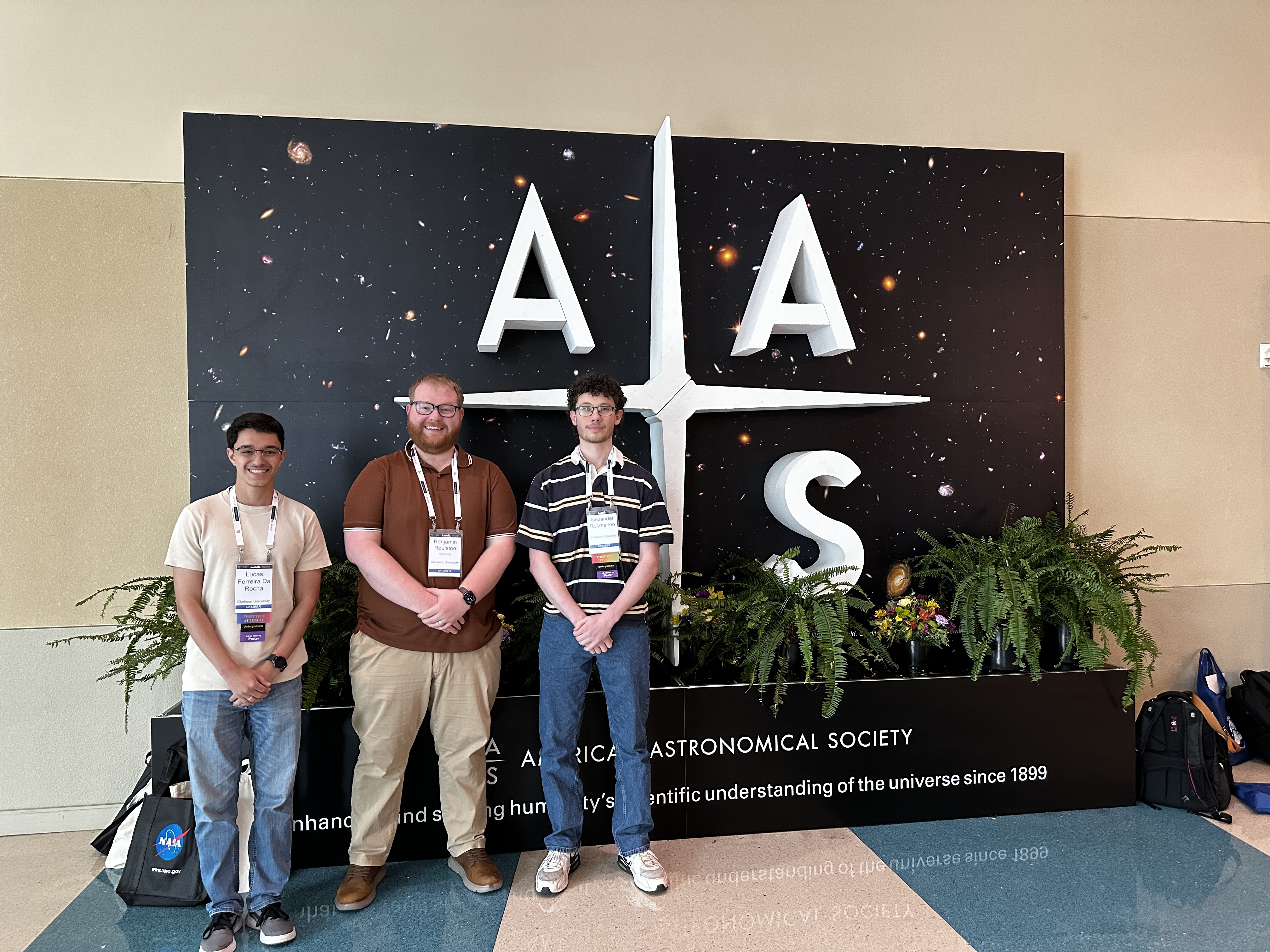
Potsdam, NY (01/30/2026) — Two Clarkson University students presented new space research at the 247th meeting of the American Astronomical Society (AAS), the world's largest astronomy conference. The event brought together more than 3,000 scientists from around the globe to share discoveries about stars, planets and the Universe.
Alexander Rosmarino, a senior majoring in aeronautical engineering, and Lucas Borges Ferreira da Rocha, a junior double majoring in physics and aeronautical engineering in the Honors Program, both presented research posters at the meeting. The conference was held in Phoenix and included around a thousand scientific presentations.
Their work focuses on unusual stars called dwarf carbon stars, which have higher amounts of carbon than regular stars. These dwarf carbon stars help scientists better understand how stars live, change and interact over billions of years. Learning how stars evolve also helps researchers understand the history of our galaxy, including how elements like carbon are spread through space.
Rosmarino's research studied stars that once stole material from a nearby companion star. Scientists believed this process should make the stars spin very fast and glow strongly in X-rays. Using data from NASA's Chandra X-ray Observatory and the Hubble Space Telescope, Rosmarino found something surprising: the stars were quiet and slow-spinning instead.
By studying ultraviolet light from Hubble, he also measured the temperature of a hidden companion star, called a white dwarf. His results show the system is about 1 billion years old and should still be spinning quickly. This challenges current ideas about how these stars form and age. Rosmarino is now preparing his findings for publication in The Astrophysical Journal, a leading scientific journal in astronomy.
Rocha's research used data from NASA's Transiting Exoplanet Survey Satellite, or TESS. He studied thousands of images to track how the brightness of stars changes over time. Through this work, Rocha discovered the first known eclipsing dwarf carbon star system. These are systems where one star passes in front of the other, causing a dip in brightness.
This discovery is important because eclipsing systems allow scientists to measure star sizes and masses more accurately. Until now, that kind of detailed modeling was not possible for dwarf carbon stars. Rocha will continue this work at Clarkson, helping scientists better understand how these rare stars are formed.
Both students also took part in a two-day workshop at the conference to learn the Julia programming language, a powerful tool used to analyze astronomy data.
Their research shows how Clarkson students are helping answer big questions about the universe and pushing science forward.
Media Attachments